
Celtic Tattoo Symbols and Their Meanings: Triquetra, Trinity Knot & Claddagh
Celtic tattoo symbols endure because they manage to be three things at once: visually striking, genuinely old (or at least older than most tattoo flash), and dense with meaning you can actually explain when someone asks. This guide covers the symbols people most often choose — the Triquetra (Trinity Knot), the Claddagh, knotwork, the Celtic cross, and Ogham script — with an honest account of what each one historically meant, what it has come to mean, and what is worth knowing before it becomes permanent.
The Triquetra / Trinity Knot
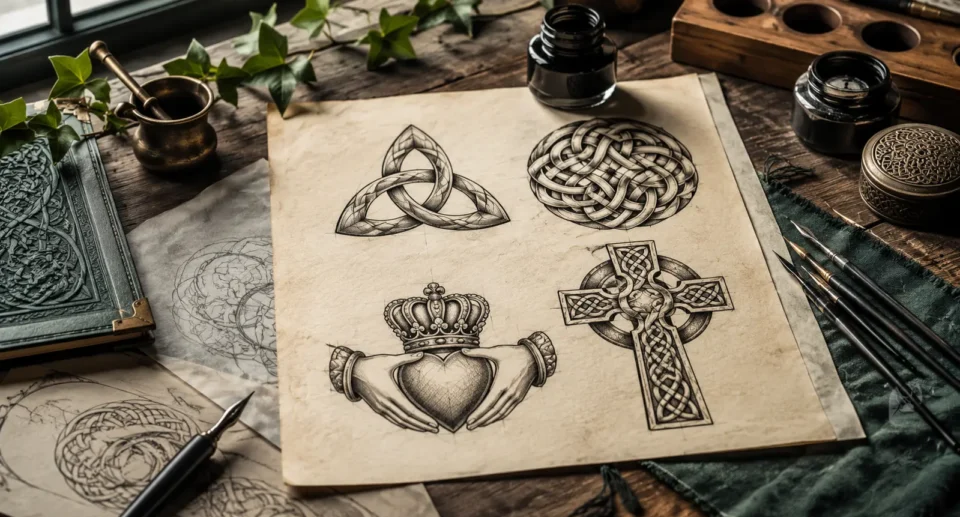
The triquetra — three interlocked arcs forming a continuous, unbroken design — is probably the most tattooed Celtic symbol of all. It appears in early medieval insular art, most famously in the Book of Kells, and its power as a tattoo lies in its layered readings: in Christian tradition, the Holy Trinity; in modern Pagan readings, the triple goddess (maiden, mother, crone) or the unity of land, sea, and sky; and in an entirely secular register, three of anything that matters to you — past, present, future; three children; three generations. The honest caveat: its use as a standalone “ancient Celtic symbol of X” is largely modern — in the manuscripts it appears mostly as ornament. That does not weaken it as a tattoo; it means the meaning you bring to it is the meaning it carries. For the full history, see our Triquetra and Trinity Knot guide.
The Claddagh
The Claddagh — two hands holding a crowned heart — is not ancient at all, and that is part of its charm: it is a Galway design from around the late 17th century, traditionally credited to the goldsmith Richard Joyce, and its meaning has been stable and explicit ever since: the hands are friendship, the heart is love, the crown is loyalty. As a tattoo it carries the same grammar the ring does — it can honor a partner, a family bond, or Irish heritage itself, and some wearers even preserve the ring’s orientation conventions (pointing inward for a heart that is taken). Read the full story in our Claddagh ring guide.
Knotwork: The Endless Line
Interlaced Celtic knotwork — the unbroken, over-and-under line with no beginning or end — is the visual language most people mean by “a Celtic tattoo.” Its golden age was the early medieval period, in illuminated manuscripts and high crosses, rather than the pre-Christian Iron Age most people assume. The most common tattoo reading — eternity, continuity, the interconnection of all things — is a modern interpretation, but a natural one: the design literally has no end. Knotwork also works as a frame or band (armbands, half-sleeves) around other symbols on this list. Our guide to Celtic knots covers the major patterns, and Celtic woven patterns traces the broader tradition.
The Celtic Cross
The Celtic cross — a cross with a ring around the intersection — marks the meeting point of Christian and older traditions in Ireland and Britain, standing in carved stone since roughly the 8th century. As a tattoo it usually signals faith, heritage, or remembrance (it is a common memorial tattoo), often filled with knotwork panels in the manner of the great high crosses. One thing worth knowing: some plain “sun cross” variants (a ring-and-cross without the elongated shaft) have been appropriated by hate groups in some countries — the ornate, knotwork-filled Irish high cross form carries no such baggage, but it is worth being deliberate about the design. See our full guide to Celtic crosses.
Ogham Script: A Name in Stone, on Skin
For something quieter and more personal, Ogham — Ireland’s earliest native script — renders a name or word as a stack of strokes along a single stemline, exactly as it runs along the edge of a 5th-century standing stone. Since Ogham inscriptions were overwhelmingly names and lineages, an Ogham tattoo of a name is arguably the most historically faithful Celtic tattoo there is: it uses the script for precisely what it was invented to do. Two practical cautions: transliteration matters (Ogham has 20 core letters and no direct equivalents for some English sounds), so double-check the spelling with a reliable source before inking; and orientation matters (traditionally read bottom-to-top). Our complete Ogham alphabet guide includes every letter and its traditional tree association.
Choosing Well: Meaning, Accuracy, and Respect
- Know which layer of history you are wearing. Knotwork and the triquetra are early medieval; the Claddagh is 17th-century Galway; Ogham is 4th-6th century; most “ancient Celtic meanings” attached to them are modern. None of that makes a tattoo less meaningful — it makes you the rare wearer who can explain it accurately.
- Verify any script. For Ogham (or Irish-language text), confirm spelling and direction with more than one source — tattoo regret in a 1,500-year-old alphabet is still tattoo regret.
- Placement suits the form. Ogham works with the body’s long lines (forearm, spine, calf); knotwork bands suit wrists and arms; standalone triquetras and Claddaghs read cleanly at almost any size.
For the wider world these designs come from, our Celtic symbols and meanings hub maps every symbol family on the site.
Frequently Asked Questions
What does a Triquetra (Trinity Knot) tattoo mean?
Its three interlocked arcs are most often read as the Holy Trinity in Christian tradition, the triple goddess in modern Pagan readings, or any meaningful trio — mind, body, spirit; past, present, future. Historically it appears as ornament in early medieval manuscripts like the Book of Kells; the standalone symbolic readings are largely modern.
Is a Claddagh tattoo authentically Celtic?
It is authentically Irish rather than anciently Celtic — the design dates to Galway around the late 17th century. Its meaning has been consistent ever since: friendship (hands), love (heart), and loyalty (crown).
What is the most historically accurate Celtic tattoo?
An Ogham inscription of a name makes a strong claim: Ogham was Ireland’s own script, and carving names permanently was its original, documented purpose. Just verify the transliteration carefully before committing.