Fionn mac Cumhaill and the Fianna: Ireland’s Greatest Hero Explained
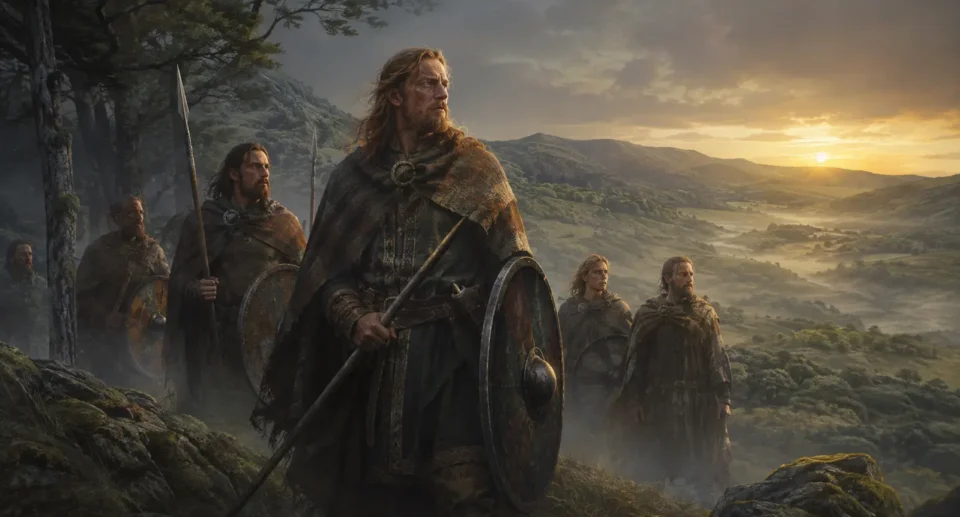
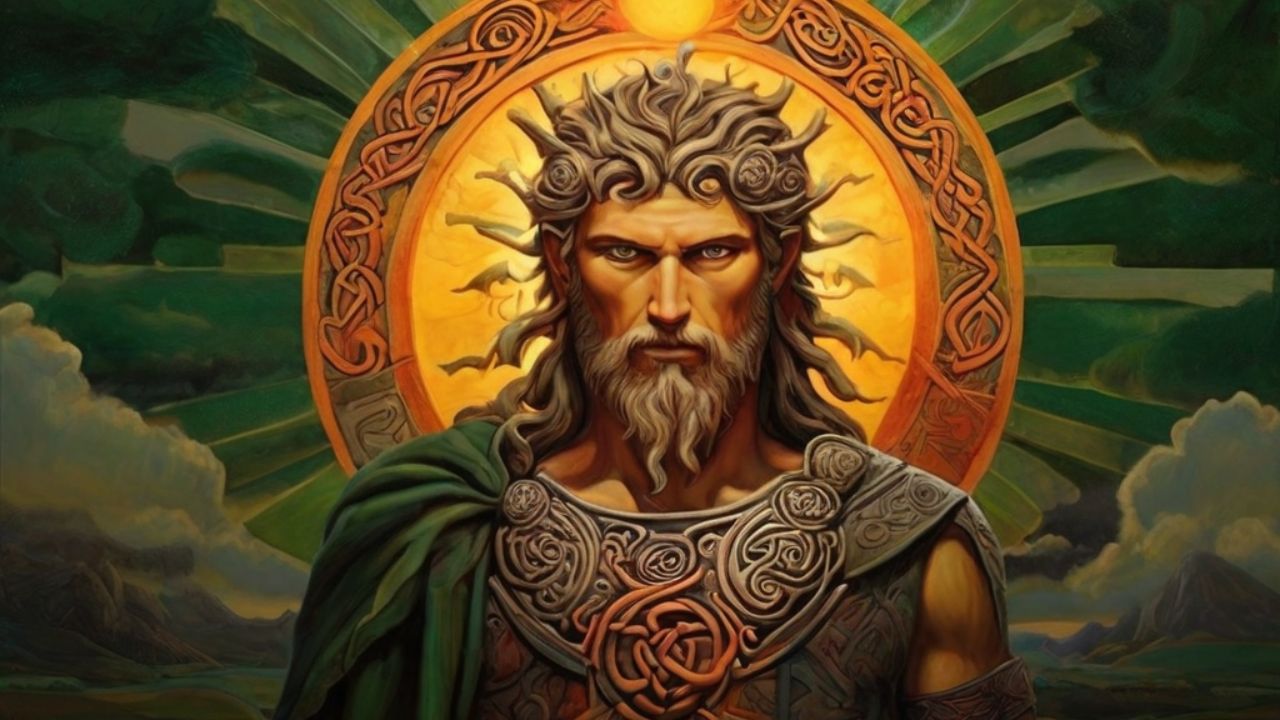
Fionn mac Cumhaill (anglicized as Finn McCool) is the great hero of Irish mythology’s Fenian Cycle — hunter, warrior, poet, and leader of the Fianna, the legendary war bands of ancient Ireland. His stories stretch from the boy who accidentally tasted the Salmon of Knowledge to the old chief betrayed by love, and they remain among the most told, retold, and localized tales in the Gaelic world — there is scarcely a hill in Ireland or the west of Scotland without a Fionn story attached to it.
Who Was Fionn mac Cumhaill?
Fionn was born Deimne, son of Cumhall — leader of the Fianna before him — who was killed before Fionn’s birth by Goll mac Morna in a struggle over the leadership. Raised in secret in the forest of Sliabh Bladhma by two foster mothers, the druidess Bodhmall and the warrior woman Liath Luachra, the boy earned the name Fionn (“fair,” “bright”) for his pale hair. His training was deliberately double: woodcraft, hunting, and war from Liath Luachra; poetry and learning from the druids. That combination — warrior and poet in one — is the whole key to his character, and to what the Fianna themselves were supposed to be.
The Salmon of Knowledge
The most famous of all Fionn stories concerns his apprenticeship to the poet Finegas beside the River Boyne. Finegas had spent seven years trying to catch the Salmon of Knowledge, which had eaten the hazelnuts of wisdom that fell into the Well of Segais. When he finally caught it, he set the boy to cook it — with strict instructions to eat none. A blister rose on the fish’s skin; Fionn pressed it down with his thumb, burned himself, and put the thumb in his mouth. All the fish’s wisdom passed to him in that instant. Ever after, Fionn had only to bite his thumb to know the answer to any question. We tell the full story in our article on the Salmon of Knowledge.
The Fianna: Ireland’s Legendary War Bands
The Fianna were not a standing army but something stranger and more romantic: bands of landless young warriors who lived outside ordinary society, hunting and camping across Ireland in summer and quartering on households in winter, serving the High King but belonging to no lord. Fionn won their leadership as a young man by avenging his father and, in the most famous telling, by slaying the fire-breathing fairy Aillén, who burned Tara each Samhain after lulling its defenders to sleep with music — Fionn stayed awake by pressing his own spear-point to his forehead.
Entry to the Fianna, the medieval texts insist, demanded feats that would thin out any modern special-forces selection: a candidate was buried to the waist and had to defend himself with a shield and hazel stick against nine spearmen; he had to run through the forest at full speed without a single braid of his hair being loosened by a branch, leap a bough at head height, pass under one at knee height, and pluck a thorn from his foot without slowing — and he had to be a poet, versed in the twelve books of poetry. The Fianna’s ideal, like Fionn’s own upbringing, fused the wild and the learned.
The Great Names of the Fianna
- Oisín — Fionn’s son, the poet of the Fianna, whose journey to Tír na nÓg with Niamh is told in our article on Tír na nÓg.
- Oscar — Oisín’s son, the mightiest warrior of the third generation.
- Diarmuid Ua Duibhne — the beautiful warrior with the love-spot, fated to be loved by women and to die on the tusks of a boar.
- Caílte mac Rónáin — the swiftest runner of the Fianna and, in tradition, one of its last survivors and storytellers.
- Goll mac Morna — his father’s killer and his uneasy ally: the Fianna’s stories are full of the tension between the two rival clans within it.
Diarmuid and Gráinne: The Betrayal That Broke the Fianna
In old age, Fionn was betrothed to Gráinne, daughter of the High King — a young woman who took one look at her aging bridegroom and placed a geis (a binding magical obligation) on Diarmuid to run away with her. The pursuit of Diarmuid and Gráinne across Ireland lasted years; every dolmen in the country is folklorically a “bed of Diarmuid and Gráinne.” When Diarmuid was finally gored by the great boar of Benbulbin, Fionn — who could heal any wound with water carried in his cupped hands — twice let the water slip through his fingers before relenting too late. It is the moment the stories stop flattering their hero: jealous, aging, and small in the one act where greatness mattered most.
Fionn in the Landscape: The Giant’s Causeway and Beyond
Later folk tradition remembered Fionn less as a hero-king and more as a literal giant — most famously in the tale of the Giant’s Causeway, which he builds as stepping-stones to Scotland to fight the Scottish giant Benandonner, and escapes by being disguised by his wife Oonagh as her own baby (if the infant is that size, Benandonner reasons, the father is best avoided — and he tears up the causeway as he flees). The Isle of Man is, in the same tradition, a clod of earth Fionn hurled at a fleeing rival. These giant-tales are later and more playful than the Fenian Cycle proper, but they show how completely Fionn saturated the Gaelic landscape.
Did Fionn Ever Die?
The traditions disagree — and the most enduring says no. Like Arthur in Britain, Fionn is a sleeping hero: he and the Fianna lie in a cave beneath Ireland (or Scotland — both claim him), waiting to wake in the hour of the Gaels’ greatest need. The Fenian Cycle’s own frame story makes the survival literal: Oisín and Caílte, having outlived the Fianna by centuries, recount its deeds to St. Patrick himself — the old world telling its stories directly to the new.
Frequently Asked Questions
Are Fionn mac Cumhaill and Finn McCool the same figure?
Yes — Finn McCool is simply the anglicized spelling of Fionn mac Cumhaill. The giant of the Giant’s Causeway legend and the leader of the Fianna are the same character at different stages of the tradition’s development.
What were the Fianna?
Bands of landless young warrior-hunters in Irish mythology who lived outside ordinary society, served the High King, and demanded both physical prowess and poetic learning of their members. Fionn mac Cumhaill was their greatest leader.
How did Fionn mac Cumhaill get his wisdom?
By accident: cooking the Salmon of Knowledge for the poet Finegas, he burned his thumb on the fish and sucked it, receiving all its wisdom. Thereafter he could access that knowledge by biting his thumb.