What Is a Banshee? Irish Folklore’s Death Omen Explained
Long before a death was confirmed by a letter, a telegram, or a phone call, some Irish families believed they would already know. A cry would rise outside the house at night — not quite human, not quite wind — and by morning, word would come that someone had died. That cry belonged to the banshee: Ireland’s most enduring death omen, and one of the few figures in Irish folklore who is not a memory of the past so much as a warning about what is coming.
What Does “Banshee” Actually Mean?
The word comes from the Irish bean sí — “woman of the fairy mound.” Sí (also written sídhe) refers to the ancient earthen mounds scattered across the Irish countryside, long believed to be doorways into the Otherworld and the dwelling places of the fairy folk. A bean sí, then, is not simply a ghost — she is understood as a fairy woman, tied to a specific and much older layer of Irish belief than the word “banshee” (its English-language spelling) might suggest on its own.
The Banshee and the Keening Women
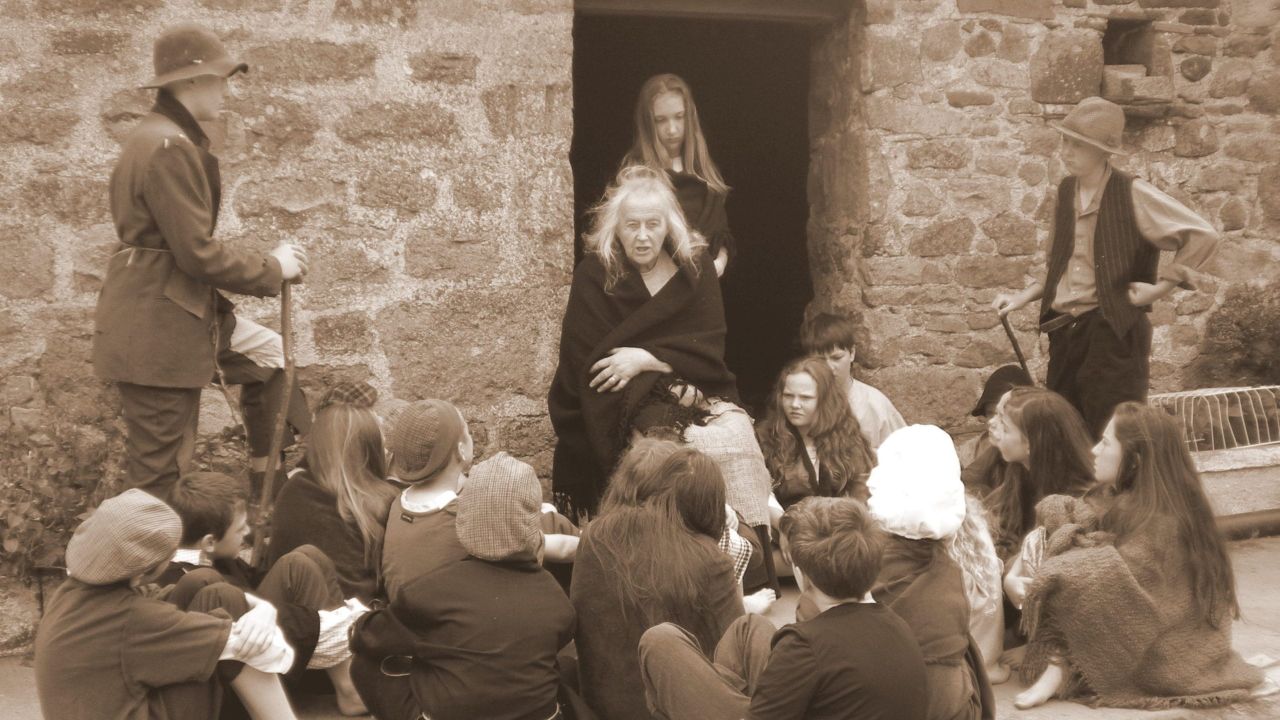
The banshee’s wail did not come from nowhere — it is the supernatural mirror of a very real Irish tradition: keening (caoineadh, literally “weeping”), the practice of professional mourners, almost always women, who wailed ritual laments over the dead at wakes and funerals. If you have not already, read our piece on the keening women for the human side of this tradition.
Folklore took that very human role and gave it a supernatural counterpart. Where a keening woman mourned a death that had already happened, the banshee’s cry was said to arrive before the death was known — sometimes the very first sign a household had that someone, often far away, had died. In a world without fast communication, that is a genuinely unsettling kind of omen: grief arriving ahead of the news that should have caused it.
Which Families Had a Banshee?
Not every family, according to tradition, warranted a banshee’s attention. The belief held that she attached herself to families of old Gaelic (“Milesian”) stock — specifically those bearing surnames beginning with Ó or Mac/Mc, the hallmark of ancient Irish lineage. Families of later Norman, Anglo-Norman, or English descent were traditionally excluded, though folklore made room for exceptions: a family that had lived in Ireland long enough, or that produced someone “gifted with music and song,” might earn a banshee of their own regardless of surname.
Some accounts go further and name specific banshees tied to specific families — the O’Brien family’s banshee, Aibell, was said to command twenty-five other banshees beneath her. The Bunworth family of County Cork had a banshee well-documented enough to appear in 19th-century folklore collections. A banshee, in other words, was not a generic spirit — she was, in a sense, part of the family.
What Did She Look Like?
Descriptions vary widely, which is itself telling — this is a figure shaped by oral tradition passed down across regions and centuries, not a single fixed image. Common threads across accounts include:
- Long, flowing hair, which she is sometimes described as combing while she wails
- A grey cloak worn over a green dress, in some tellings
- Red, swollen eyes — from centuries of weeping
- A form that might appear as an old woman, or as a young woman who died with unusual musical talent, or barely a form at all — a shrouded shape glimpsed beneath a tree or moving through moonlight
One 17th-century account, from the memoir of Lady Ann Fanshawe, describes a banshee dressed in white with red hair and a ghastly, corpse-like complexion — a description strikingly different from the grey-cloaked figure more commonly pictured today. That inconsistency is not a flaw in the tradition; it is a sign of how long and how widely this belief traveled.
The Banshee Beyond Ireland
Ireland’s banshee has close relatives elsewhere in the Celtic world. In Scottish folklore, the bean nighe (“little washerwoman”) is said to be seen at streams, washing the bloodstained clothes of those who are about to die — a different image, but the same essential role: a female spirit whose presence is itself a warning. Welsh tradition has its own version in the cyhyraeth, a disembodied wailing voice with a similar death-omen function. None of these are the same figure, exactly, but they clearly come from a shared, older well of belief about mourning, warning, and the boundary between the living and the dead — a boundary explored more fully in our guide to Celtic death rites.
Is the Banshee Real?
That is really a question about belief rather than evidence — and it is worth taking seriously as a question, not dismissing. What is historically documented is the belief itself, and it is old: references to banshee-like figures appear as far back as the 14th century, in the Cathreim Thoirdhealbhaigh (“The Triumphs of Torlough”), and the tradition was still being recorded as a living, seriously-held belief by folklorists like Lady Wilde and W.B. Yeats in the 19th and early 20th centuries — not as a fading superstition, but as something people in living memory genuinely expected to hear.
Whether or not you take the omen literally, the banshee endures because of what she represents: grief given a voice, and a death given a warning, in a culture that took both very seriously.
Frequently Asked Questions
Is a banshee good or evil?
Neither, in most traditional accounts. She is not depicted as a malicious spirit who causes death — she is a messenger, foretelling a death that is already going to happen. Her cry is a warning, not a curse.
What does it mean if you hear a banshee?
In traditional belief, hearing her wail meant a death was coming, usually within the family she was attached to. It was not considered something you could prevent — only something you had been warned about.
Is the banshee the same as a ghost?
Not exactly. A banshee is understood in Irish folklore as a bean sí — a fairy woman connected to the ancient sídhe mounds — rather than the spirit of a specific dead person, which is the more common definition of a ghost.