The Celtic Wheel of the Year: Samhain and the Eight Festivals Explained
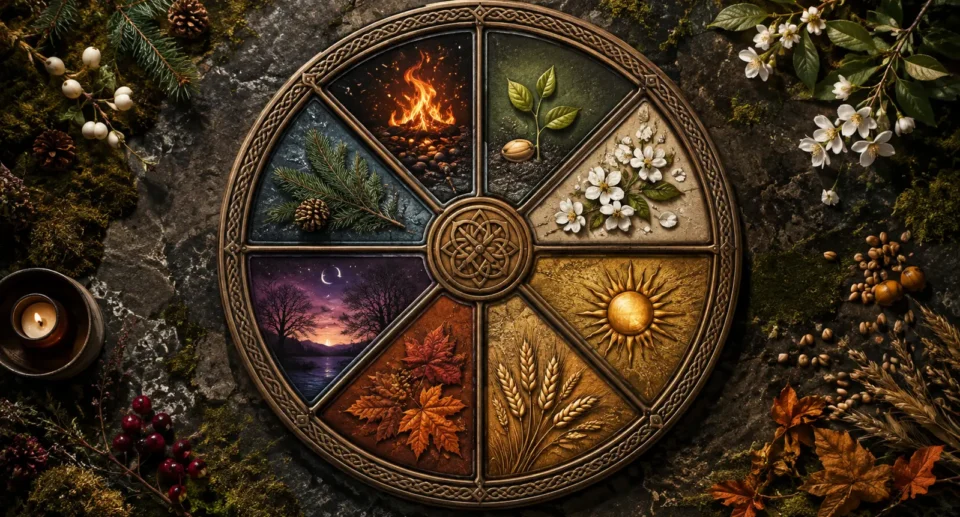
The Celtic Wheel of the Year is the cycle of eight seasonal festivals — four ancient Gaelic fire festivals (Samhain, Imbolc, Beltane, and Lughnasadh) interwoven with the solstices and equinoxes — that together mark the turning of the seasons in Celtic and modern Pagan tradition. Some of it is genuinely ancient; some of it is a modern arrangement of ancient pieces. Both halves of that story are worth telling honestly.
The Four Fire Festivals: The Ancient Core
The oldest layer of the wheel is the four cross-quarter festivals — the days that fall roughly midway between a solstice and an equinox. These are documented in early Irish literature and law texts, and they divided the Gaelic year into its working seasons: when to bring cattle in, when to let them out, when to harvest, and when the boundary between this world and the Otherworld grew thin.
Samhain (October 31 – November 1): The Celtic New Year
Samhain (pronounced SAH-win) is the hinge of the whole year — the festival marking summer’s end, the final harvest, and the descent into the dark half of the year. Cattle were brought down from summer pasture, some slaughtered for winter stores, and great bonfires were lit whose embers relit every household hearth. Medieval Irish tales treat Samhain as the night when the sídhe mounds stood open and the dead and the fairy folk moved freely — which is why offerings were left out, why disguises were worn against wandering spirits, and why Samhain is the direct ancestor of Halloween. The medieval texts place many of Irish mythology’s pivotal events at Samhain precisely because it was understood as a night outside normal time.
Imbolc (February 1): First Stirrings
Imbolc marks the first signs of spring — traditionally tied to the beginning of lambing season and the lactation of ewes (one proposed root of the name is i mbolg, “in the belly”). It is deeply associated with the goddess and later saint Brigid: households wove Brigid’s crosses from rushes, left cloth out overnight for her blessing, and welcomed her symbolically across the threshold. Of all the fire festivals, Imbolc survived most visibly inside Christian tradition, as St. Brigid’s Day — since 2023 a public holiday in Ireland.
Beltane (May 1): The Bright Fire
Beltane opened the summer half of the year, when cattle were driven out to summer pasture between two bonfires for protection and blessing — a ritual recorded in Irish sources as early as the 10th century. Like Samhain, it was a threshold night when the Otherworld pressed close, but with the opposite mood: fertility, growth, and light. May bushes, dew-washing at dawn, and fire-leaping all belong to Beltane’s long afterlife in folk custom.
Lughnasadh (August 1): The Harvest Games
Lughnasadh is the festival of the first harvest, named for the god Lugh, who according to myth founded it as funeral games for his foster-mother Tailtiu, who died clearing Ireland’s plains for agriculture. Its historical celebrations — the Tailteann Games — included athletic contests, horse racing, trading, and match-making, and echoes survive in hilltop pilgrimage traditions like Reek Sunday at Croagh Patrick.
The Solstices and Equinoxes: The Other Four Spokes
The wheel’s remaining four points — the winter and summer solstices and the spring and autumn equinoxes — are astronomically real and were clearly significant to prehistoric peoples in Ireland and Britain: Newgrange is aligned to the midwinter sunrise, Stonehenge to the solstices. But here is the honest part: there is little evidence the historical Gaelic Celts celebrated the solstices and equinoxes as calendar festivals the way they demonstrably did the four fire festivals. The familiar names — Yule, Ostara, Litha, Mabon — come from Germanic tradition or are modern coinages, not Gaelic ones.
So Is the Eightfold Wheel Actually Ancient?
The eight-spoke wheel as a single unified system is a modern synthesis, assembled in the mid-20th century within the modern Pagan and Wiccan revival, which interleaved the four genuinely ancient Gaelic fire festivals with the four solar stations. That does not make it hollow — it makes it a living tradition built from authentically old parts, much like the Ogham tree-alphabet tradition: an ancient core, a medieval layer, and a modern arrangement, each meaningful on its own terms. The four fire festivals themselves need no such caveat — Samhain, Imbolc, Beltane, and Lughnasadh are among the best-attested features of the pre-Christian Gaelic year.
The Dark Half and the Light Half
Beneath the eight festivals lies a simpler and older division: the Gaelic year split in two at Samhain and Beltane — the dark half (an dorchadas) and the light half. Scottish tradition personifies this handover in the Cailleach, the winter hag who rules from Samhain to Beltane before yielding to the growing year. Understanding that two-part rhythm explains why Samhain and Beltane are the year’s two great threshold nights — the moments when one world hands over to another, in both the seasonal and the supernatural sense.
The Wheel Today
The wheel is very much alive: Samhain’s descendant Halloween is a global holiday, Imbolc persists as St. Brigid’s Day, Beltane fires still burn (Edinburgh’s Beltane Fire Festival draws thousands), and Puck Fair and Reek Sunday carry Lughnasadh’s DNA. Modern Pagans and Druids celebrate all eight spokes as a devotional calendar, and many people with no religious stake at all use the wheel simply as a way of paying attention to the turning year. For the symbols that mark these festivals, see our guide to Celtic symbols and their meanings; for the deities behind them, the Celtic gods and goddesses hub.
Frequently Asked Questions
What is the Celtic Wheel of the Year?
It is the cycle of eight seasonal festivals — Samhain, Imbolc, Beltane, and Lughnasadh (the four ancient Gaelic fire festivals) plus the two solstices and two equinoxes — used to mark the turning of the year in Celtic-inspired and modern Pagan tradition.
Is Samhain the Celtic New Year?
Samhain marked the end of the harvest and the start of the dark half of the year, and it is widely regarded as the old Gaelic new year — the moment the annual cycle reset. It is also the direct ancestor of Halloween.
Are all eight festivals genuinely ancient?
The four fire festivals (Samhain, Imbolc, Beltane, Lughnasadh) are well-attested in early Irish sources. The solstices and equinoxes mattered to prehistoric monument-builders, but the unified eightfold “wheel” combining them is a 20th-century synthesis from the modern Pagan revival.