

Scotch Eggs: A Classic of British & Scottish Fare
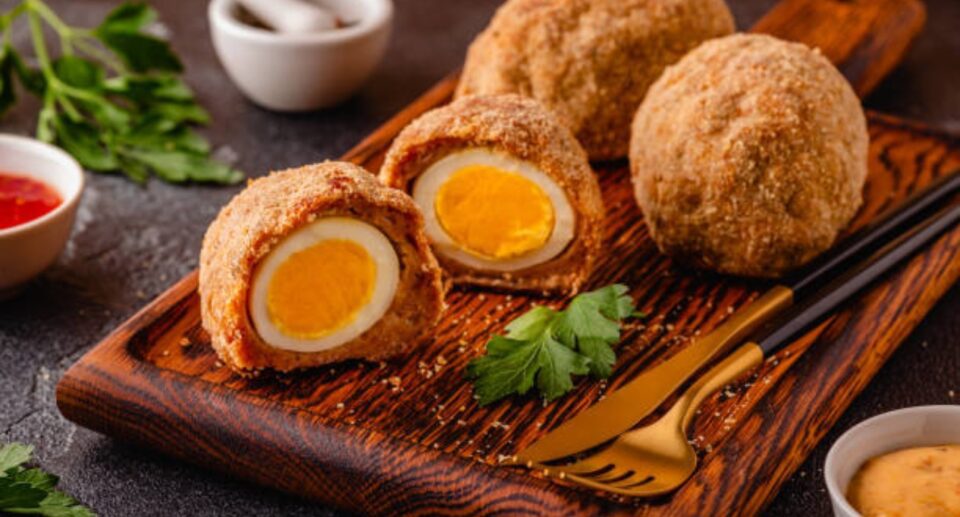
Few foods carry the quiet authority of the Scotch egg. It does not dazzle with ornament. It does not depend on rare ingredients. Yet this modest union of egg and sausage, wrapped in crumbs and fried to a golden crust, has endured for centuries. It appears in picnic hampers, at pub counters, and during country fairs across Britain.
At first glance, it seems simply British. But if we look more closely, through the lens of cultural memory, rural practice, and Celtic hospitality, we find deeper resonances.
What Is a Scotch Egg?
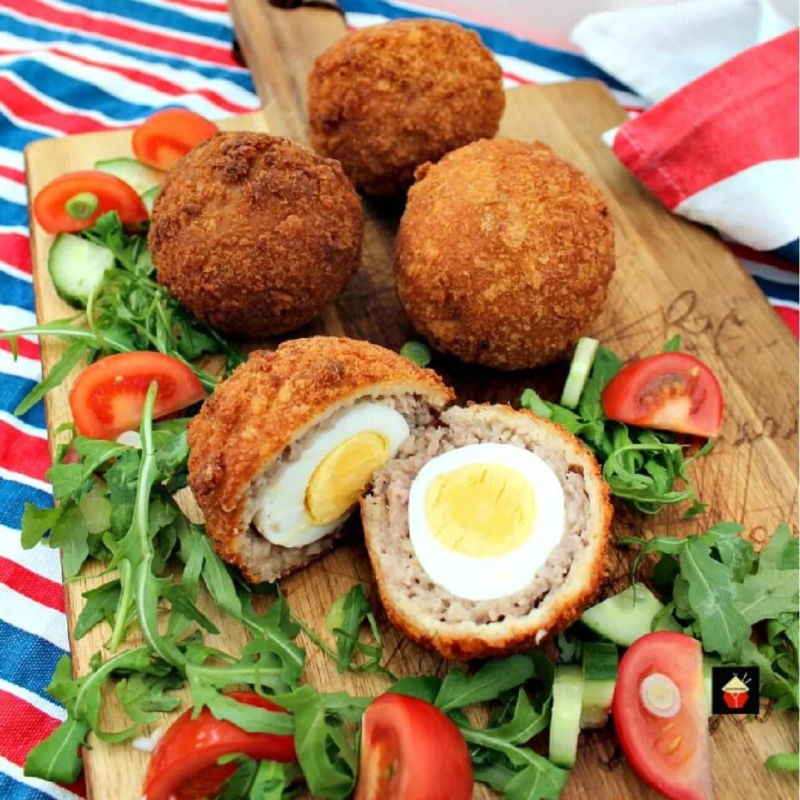
A Scotch egg consists of a soft or hard-boiled egg encased in seasoned sausage meat, coated in breadcrumbs, and fried or baked until crisp. When cut in half, the cross-section reveals a striking contrast: golden yolk, pale white, savoury meat, and crunchy crumb.
It is portable, stores well, and nourishes generously. These qualities made it ideal for rural labourers, travellers, and hunters moving across the landscapes of Scotland and northern England.
In that sense, it belongs to the same world of practicality that shaped crofting communities, as explored in A Crofter’s Journey Through Time (https://celtguide.com/crofters-journey-through-time/). Food had to sustain both body and spirit.
The Origins: London Invention or Scottish Legacy?
Many culinary historians credit the London department store Fortnum & Mason (1738) with popularising the Scotch egg in the eighteenth century. Yet the name itself invites debate. Why “Scotch”?
Some suggest the term refers to the method of “scotching” meat, mincing or finely chopping it. Others argue that the dish reflects Scottish preservation traditions, where coating and frying extended shelf life.
Scotland’s culinary heritage values hearty, practical fare shaped by climate and terrain. If you consider the environmental conditions discussed in Kilts and Weather in Scotland (https://celtguide.com/kilts-weather-scotland/), you begin to see why dense, protein-rich foods mattered. Cold winds demand sustenance.
The Scotch egg may not have emerged from a Highland glen, but it aligns closely with Scotland’s culinary logic.
Scotch Eggs and Celtic Hospitality
Celtic culture prizes generosity. Gatherings revolve around shared food, music, and storytelling. Think of the warmth of céilí gatherings described in Ceili Bands (https://celtguide.com/ceili-bands/). While fiddles sing and bodhráns pulse, plates circulate.
In such settings, the Scotch egg thrives. It requires no elaborate serving ritual. You slice it and share it. Its form invites communal enjoyment.
Hospitality also shapes Irish celebrations like those explored in The Significance of Saint Patrick’s Day (https://celtguide.com/the-significance-of-saint-patricks-day/). Though more associated with England today, the Scotch egg easily finds its place at Celtic festivals, Highland Games, and rustic outdoor feasts.
A Traditional Scotch Egg Recipe
Let us approach the matter practically.
Ingredients
- 6 large eggs
- 500g high-quality pork sausage meat
- 1 teaspoon English mustard
- Fresh parsley, chopped
- Salt and black pepper
- 2 beaten eggs (for coating)
- Plain flour
- Breadcrumbs
- Oil for frying
Method
- Boil 6 eggs for 6–7 minutes for a slightly soft centre. Cool and peel carefully.
- Season the sausage meat with mustard, parsley, salt, and pepper.
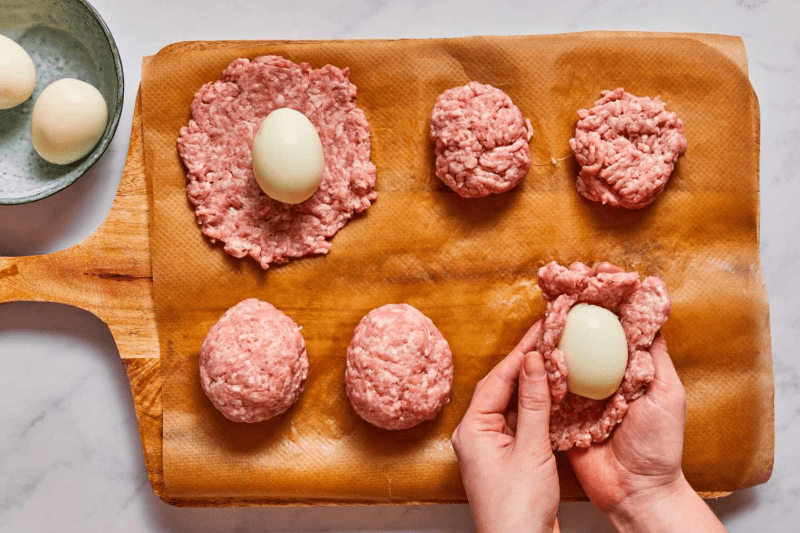
- Divide the meat into six portions. Flatten each portion in your palm.
- Wrap each boiled egg evenly in sausage meat. Seal carefully.
- Roll in flour, dip in beaten egg, and coat with breadcrumbs.
- Fry at 170°C until golden brown, about 6–8 minutes.
- Drain and rest before serving.
You may bake them for a lighter variation. Serve warm or cold.
Regional Variations
Across Britain, cooks adapt the Scotch egg to local tastes. In Scotland, you may find versions seasoned more boldly, sometimes incorporating black pudding. In contemporary gastropubs, chefs soften the yolk deliberately for visual drama.
Food evolves as culture evolves. Just as tartan developed across centuries, explored in What Is Tartan? (https://celtguide.com/what-is-tartan/) and How Long Has the Tartan Prints Been Around? (https://celtguide.com/how-long-has-the-tartan-prints-been-around/), culinary forms shift while preserving identity.
Tradition does not resist change. It absorbs it.
Scotch Eggs at Highland Gatherings
If you attend the Highland Games, see Events to Watch in Highland Games 2025 (https://celtguide.com/events-to-watch-in-highland-games-2025/), you will encounter robust food stands alongside caber tossing and pipe bands. The atmosphere blends athletic prowess with convivial feasting.
A Scotch egg fits that spirit perfectly. It offers compact strength, satisfies quickly, and complements ale and laughter.
In this way, it stands beside other symbols of Scottish identity: the tam o’shanter cap (https://celtguide.com/tam-oshanter-hat/), the tartan sash, and the music of the fiddle (https://celtguide.com/fiddle-music/). Each expresses continuity.
Nutrition and Practicality
From a nutritional standpoint, the Scotch egg delivers protein, fat, and micronutrients in balanced form. Historically, labourers required caloric density. Rural life demanded endurance.
In the same way that crofters depended on oatcakes and potatoes after the upheavals described in The Influence of the Irish Potato Famine (https://celtguide.com/the-influence-of-the-irish-potato-famine/), working families relied on portable foods. The Scotch egg met that need.
Today, health-conscious cooks experiment with lean meats or vegetarian alternatives. Yet the essential structure remains intact.
A Symbol of Simplicity
The Scotch egg embodies a wider Celtic principle: beauty in function.
Celtic stone carvings intertwine form and symbolism with disciplined precision, as explored in Celtic Stone Carvings (https://celtguide.com/celtic-stone-carvings/). Likewise, this dish layers texture and taste without extravagance. It achieves harmony through balance.
Its appeal lies in that restraint.
Conclusion: Why the Scotch Egg Endures
The Scotch egg persists because it answers fundamental human needs. It nourishes, travels well, and invites sharing.
Though debates over its origin continue, its cultural home stretches across Britain’s northern landscapes. In picnic baskets near Loch Lomond. In bustling markets. At Highland Games.
It may not sing like a clarsach or shimmer like tartan, but it carries a quieter melody, one of continuity, sustenance, and communal warmth.
In studying something as simple as a Scotch egg, we glimpse how food anchors identity. And in that anchoring, we find the enduring strength of Celtic life.