

Scottish Legends of the Cailleach (Old Woman of Winter)

In the rugged imagination of the Scottish Highlands, winter does not arrive quietly. It walks with staff in hand, cloaked in storm clouds, and crowned with frost. The Gaels call her the Cailleach, the Old Woman of Winter.
She shapes mountains, commands deer, and brings snow and biting winds. Yet she also guards the land.
The Cailleach stands among the most compelling figures in Celtic mythology. To understand her is to understand how Scotland once read its landscape as living and sacred.
For more explorations of Celtic myth, visit our blog archive:
https://celtguide.com/blog/
Who Is the Cailleach?
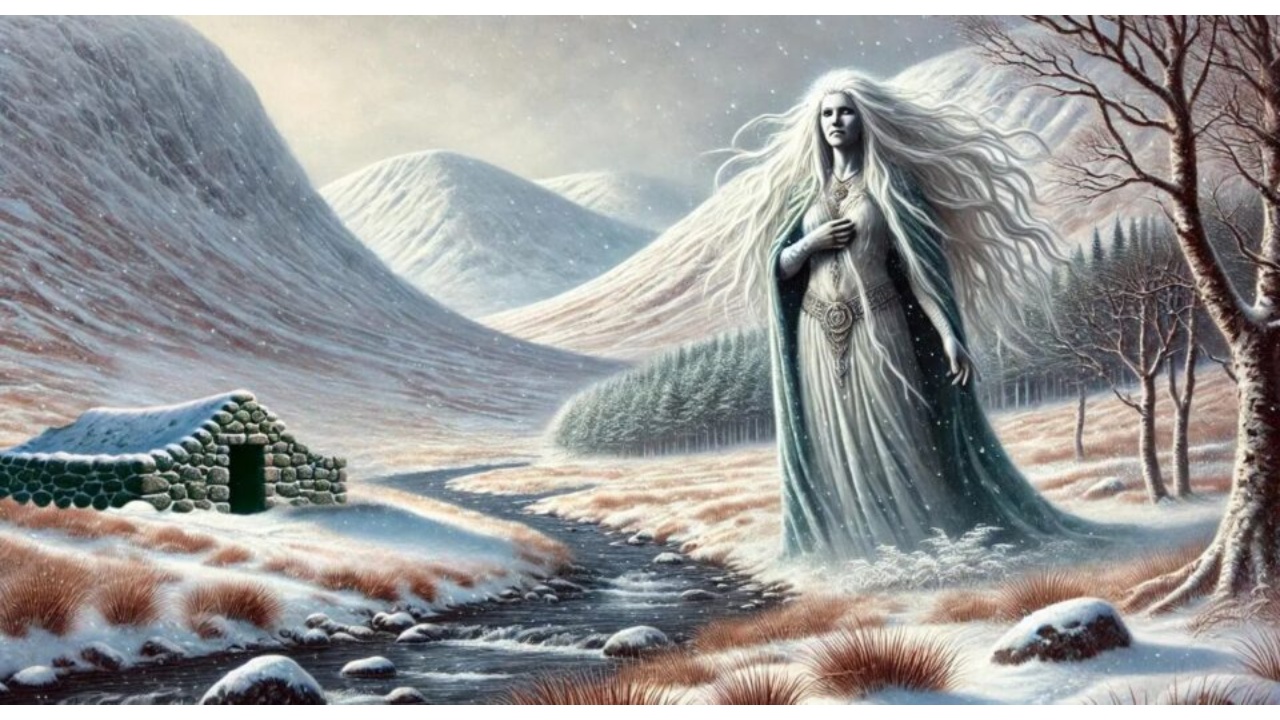
The word Cailleach means “veiled one” or “old woman” in Scottish Gaelic. In legend, she appears as a crone with blue skin, wild hair, and a hammer or staff. With a single strike, she freezes the ground. With a gesture, she summons storms.
Unlike purely malevolent figures, the Cailleach holds balance. She destroys, but she also preserves. She rules winter so that spring may return.
Her character shares thematic echoes with other Celtic deities tied to natural forces, such as the radiant sun god Lugh:
https://celtguide.com/celtic-sun-god-lugh/
Where Lugh brings light and harvest, the Cailleach brings frost and endurance. Together, they reflect the Celtic respect for seasonal cycles.
The Cailleach as Shaper of the Landscape
Scottish oral tradition credits the Cailleach with creating mountains and lochs. She drops stones from her apron to form hills. She washes her plaid in whirlpools, shaping rivers.
Many Highland landmarks carry her imprint. Travelers near Loch Lomond often hear tales of her presence in the winter mist:
https://celtguide.com/is-loch-lomond-in-the-highlands/
This mythic geography reflects an older worldview. Early communities did not see land as inert matter. They saw it as animated by story. Our article on Celtic stone carvings explores similar symbolic thinking in early Scottish art:
https://celtguide.com/celtic-stone-carvings/
The Cailleach turns landscape into narrative.
Seasonal Sovereignty: Samhain to Beltane
Tradition holds that the Cailleach rules from Samhain (early November) to Beltane (May Day). During these months, darkness lengthens. Livestock shelter indoors. Communities gather close to the hearth.
When spring approaches, she transforms into stone or relinquishes power to Brigid, the maiden of renewal. This cyclical transition reveals a profound truth: winter is not an enemy. It is a necessary passage.
The rhythm mirrors other Celtic ritual calendars and sacred transitions, much like those found in Irish seasonal traditions:
https://celtguide.com/the-significance-of-saint-patricks-day/

The Cailleach and Highland Life
For crofting communities, winter meant hardship. Snow threatened livestock. Storms tested homes. In such a climate, personifying winter gave it meaning.
The Cailleach embodied both fear and respect. She reminded communities to prepare wisely and endure patiently. In that sense, she resembles other figures rooted in communal survival, as explored in our study of the crofter’s journey:
https://celtguide.com/crofters-journey-through-time/
Folklore did not distract from reality. It helped people face it.
Storytelling and the Living Memory of the Cailleach
Why does the Cailleach endure in Scottish memory?
Because Celtic culture prizes storytelling. Stories preserve identity across generations. They encode landscape, morality, and resilience.
We explore this narrative tradition in greater depth here:
https://celtguide.com/why-are-irish-people-natural-storytellers/
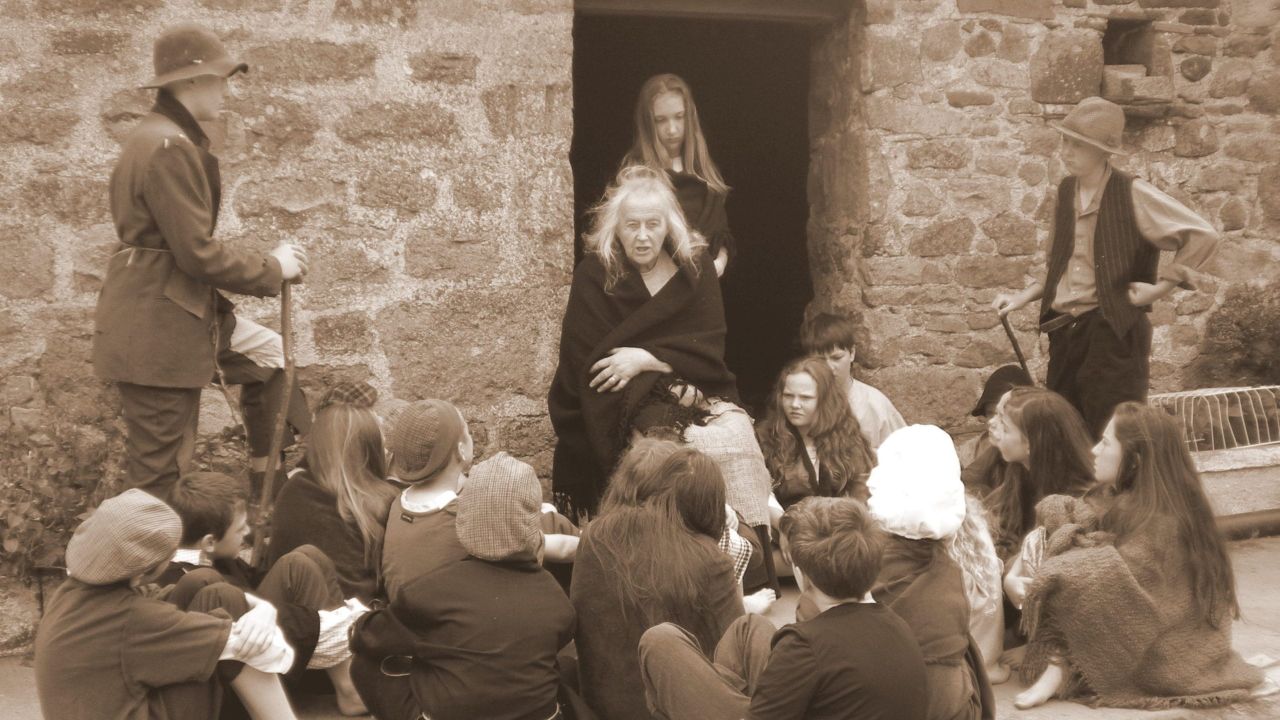
In Highland ceilidh houses, tales of the Cailleach once passed beside music and laughter. You can read about musical gatherings in our article on ceilidh bands:
https://celtguide.com/ceili-bands/
Myth lived alongside melody.

Is the Cailleach Evil?
No. She represents nature in its starkest form.
Modern readers often divide characters into heroes and villains. Gaelic cosmology resists such simplicity. The Cailleach does not seek cruelty. She governs winter because winter must come.
Even in broader Celtic mythology, we find parallel realms that challenge binary thinking, such as Annwn in Welsh tradition:
https://celtguide.com/what-is-annwn/
These myths encourage reflection rather than fear.
The Cailleach in Modern Scotland
Today, artists, scholars, and environmental thinkers revisit the Cailleach. She symbolizes ecological awareness and ancestral memory. Her story invites us to see winter not as inconvenience, but as teacher.
In a time of climate uncertainty, her myth resonates anew. She reminds us that the land commands respect.
Why the Legend Still Matters
The Cailleach embodies endurance. She teaches patience, resilience, and reverence for nature’s cycles. She anchors Scotland’s mythology in its mountains and storms.
When snow falls across the Highlands, one might still imagine her walking the ridgelines, staff striking ice from stone.
And in that vision, myth breathes again.