Porridge Stirring Traditions: Rituals of Rhythm, Care, and Culture

In Celtic households, porridge was never just breakfast. It was practice, patience, and presence. The simple act of stirring oats carried meaning shaped by land, weather, and belief. Across Scotland and Ireland, porridge stirring became a daily ritual that reflected discipline, order, and respect for sustenance.
To understand Celtic food culture, one must begin at the hearth.
Why Porridge Held Cultural Importance
Oats thrived where wheat could not. In the Highlands and much of Ireland, they became the backbone of daily nourishment. Porridge fed crofters, children, and laborers through long winters and hard seasons.
Food scarcity shaped these habits deeply. Events such as those explored in the influence of the Irish Potato Famine reinforced the cultural reverence for simple, reliable food. Porridge represented survival. Waste was unthinkable.
This necessity gave rise to care, precision, and ritual.
The Spurtle and the Act of Stirring
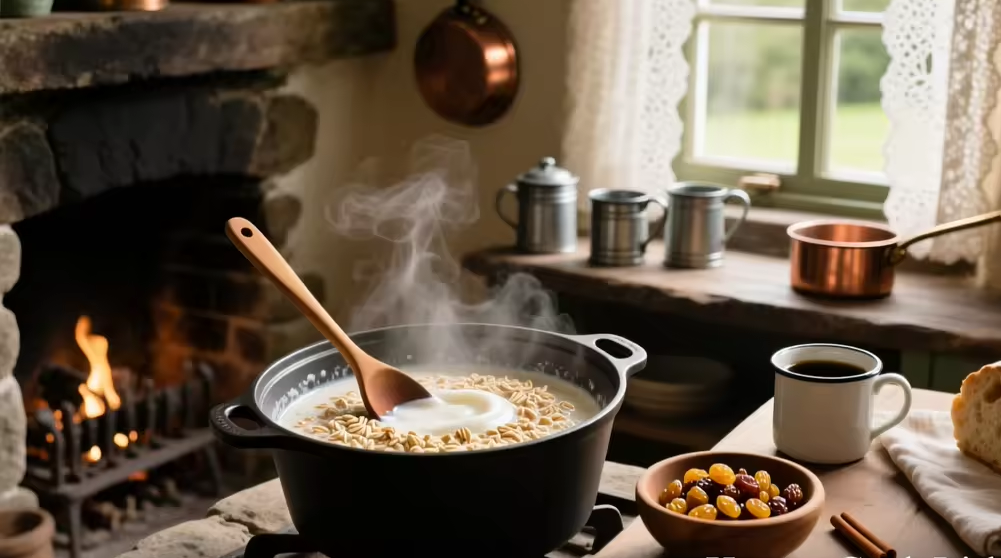
Traditional porridge required a spurtle, a slender wooden tool designed to stir oats smoothly without clumping. Its form was deliberate. Its use followed rules passed through generations.
Stirring always moved clockwise, following the sun’s path. This direction symbolized harmony and good fortune. Many believed that stirring against the sun invited misfortune or spoiled the meal’s spirit.
These small acts echo broader Celtic symbolism found in ancient art forms, including Celtic stone carvings, where circular motion and balance dominate visual language.
Porridge as a Social and Moral Practice
In many homes, the eldest woman or head of household stirred the pot. This role carried responsibility. One stirred steadily, patiently, and without haste. Children often watched before they learned.
This process taught restraint and attentiveness. The lesson mattered as much as the meal.
Celtic societies valued storytelling, rhythm, and repetition. These traits appear clearly in domestic customs, just as they do in oral traditions discussed in why Irish people are natural storytellers.
Belief, Protection, and Folk Customs
Some families marked the pot with a protective sign after stirring. Others said a quiet prayer or Gaelic phrase before serving. These gestures blended daily life with belief.
Food, faith, and folklore lived side by side. This integration reflects the same worldview that shaped mythic traditions tied to sacred vessels, such as those explored in the cauldron of Dagda.
In this context, porridge became both nourishment and offering.
Regional Variations Across Scotland and Ireland
While the core practice remained consistent, regional differences emerged.
In the Scottish Highlands, porridge was often thicker and eaten standing, especially by working men. In Ireland, it sometimes took softer forms and paired with buttermilk.
Geography shaped these habits, much like it shaped settlement life described in the crofter’s journey through time.
Despite differences, the act of stirring remained central.
The Decline and Revival of the Tradition
Industrial food altered daily rhythms. Instant oats removed time, effort, and ritual from the process. As a result, many stirring customs faded.
Yet interest has returned. Heritage cooking, slow food movements, and cultural revival have renewed appreciation for these practices. People now seek meaning in methods once dismissed as old-fashioned.
This revival mirrors wider cultural preservation seen across Celtic music, language, and domestic arts.

Why Porridge Stirring Still Matters
Porridge stirring traditions remind us that culture survives in ordinary acts. A spoon moving through oats can carry history, belief, and care. These rituals grounded communities long before written records preserved them.
In a world that moves quickly, such traditions invite us to slow down. They ask us to notice rhythm, intention, and the quiet dignity of daily nourishment.
Sometimes, heritage lives not in monuments, but in the humble circle traced by a wooden spurtle.