


Irish Straw Boy Masks: Tradition, Folklore, and Festivity

In the world of Irish folklore, masks often carry layers of meaning protection, anonymity, and transformation. Among these, the Irish Straw Boy Masks hold a particularly fascinating place. Crafted from sheaves of straw, these rustic disguises were worn by “Straw Boys” who appeared uninvited at weddings, festivals, and seasonal gatherings. Their role was playful yet symbolic: to bring luck, mischief, fertility, and community blessing.
Like the musical resonance of the Irish harp or clarsach, straw masks were not mere decoration. They were instruments of cultural expression, binding people to older Celtic customs that survived through performance and ritual.
Origins of the Straw Boy Tradition
The practice of wearing straw masks dates back centuries in rural Ireland. Historically, bands of young men, often unmarried, would arrive at wedding celebrations dressed in straw costumes, their faces concealed beneath elaborate masks. Their sudden appearance, though startling, was not hostile. Instead, it was welcomed as a sign of good fortune and community spirit.
The ritual carried echoes of pagan fertility rites. Straw, a by-product of the harvest, symbolized abundance, continuity, and renewal. This connection to the land echoes other agrarian traditions, such as the reverence for the Celtic oak tree, both embodying resilience and fertility.

The Masks Themselves
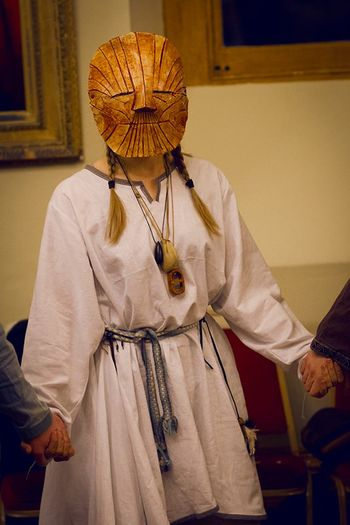
Straw boy masks were more than crude disguises. They were carefully crafted by twisting, plaiting, and binding straw into conical shapes that often covered the entire head. Eye holes allowed the wearers to peer out, while the distinctive golden sheen of straw gave the figures an otherworldly, almost spectral presence.
These masks bore striking similarities to other European folk disguises, particularly those tied to harvest festivals. Much like Celtic stone carvings, their designs blended artistry with symbolism, each strand reinforcing themes of continuity and communal memory.
Straw Boys at Weddings
One of the most enduring settings for straw boy appearances was the Irish wedding. Typically, they would arrive late in the evening, their entrance accompanied by playful noise-making, music, and dancing. Far from being disruptive, their participation was seen as essential.
- Blessings: Their presence symbolized good luck for the couple.
- Entertainment: They enlivened the gathering with humor, dance, and song, much like céilí bands still do at traditional Irish events.
- Community Inclusion: They reminded the couple that marriage extended beyond two individuals to the wider kinship network.
In this sense, straw boy masks served both a theatrical and a social function, blurring the line between misrule and blessing.

Suppression and Survival
Like many folk practices, the straw boy tradition came under pressure in the 19th and 20th centuries, as modernization, religious conservatism, and urbanization reshaped rural Ireland. Yet, just as the Irish wake continued to preserve ancestral customs, straw boying did not vanish entirely.
In some counties—particularly Kerry, Mayo, and Donegal—the practice endured, often resurfacing during folk festivals and local celebrations. It was a resilient survival of older Celtic customs, where the mask provided a bridge between everyday life and the symbolic world.

Straw Boy Masks in Modern Irish Culture
Today, straw boy masks have found new life in heritage celebrations, folkloric performances, and tourist events. They serve as a cultural marker, connecting modern Ireland to its rural past. Schools, festivals, and craft workshops often teach the art of making straw masks, preserving not only the physical craft but also the stories tied to it.
Much like the popularity of Irish storytelling, these masks remind us that culture is carried forward not in static objects but in lived, shared experiences.
Conclusion
The Irish Straw Boy Masks are far more than festive disguises. They are symbols of fertility, abundance, and communal joy, woven from the very substance of the harvest. Their survival across centuries reflects Ireland’s enduring ability to preserve its folk traditions, even in the face of change.
In their playful mischief and ritual blessing, the straw boys continue to embody the Irish spirit: rooted in the land, alive in community, and endlessly inventive in storytelling.
For more explorations of Celtic traditions and heritage, visit our Celtguide blog archive.