Irish Battering Rams in History: Siege Warfare and Strategy
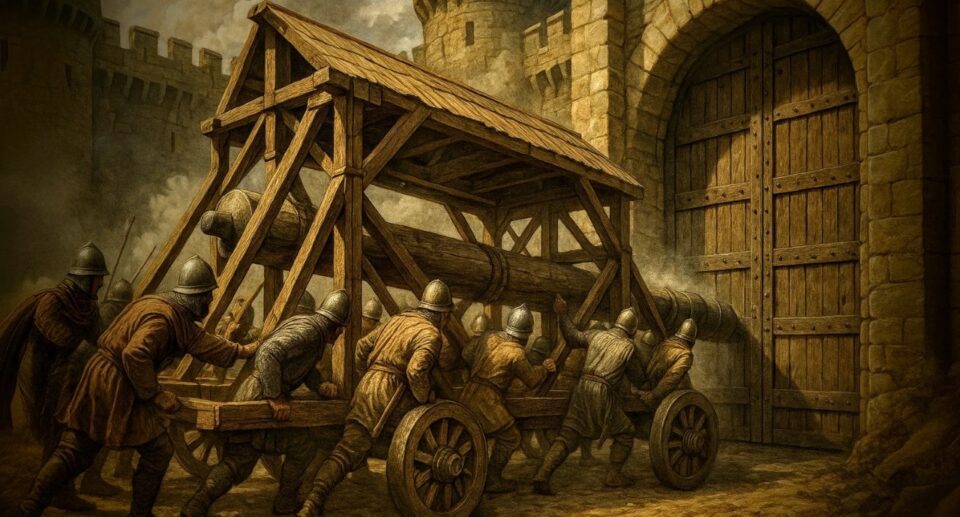
When we think of early Irish warfare, we often imagine swift raids, heroic duels, and oral traditions rich with memory. Yet, beneath these narratives lies a more structured reality. Irish warriors understood strategy, engineering, and siegecraft. Among their lesser-discussed tools stands the battering ram, a symbol of persistence and tactical force.
Irish battering rams did not mirror the monumental machines of Rome. Instead, they reflected the geography, resources, and social organization of early Ireland. To understand them is to understand how Irish warfare adapted to its own cultural landscape.
For broader cultural context, readers may explore the evolving narratives of Irish identity in the Celtguide Blog.
The Nature of Siege Warfare in Early Ireland
Ireland’s early settlements rarely resembled large fortified cities. Instead, power centered around ringforts, hillforts, and royal sites such as the Hill of Tara. These locations served as political and ceremonial hubs.

Because these structures relied heavily on timber and earth, siege tactics required adaptability. Rather than prolonged sieges, Irish warfare favored rapid assaults. Battering rams, therefore, were likely smaller, mobile, and designed for quick deployment against gates or wooden defenses.
What Did Irish Battering Rams Look Like?
Unlike the iron-shod rams of classical antiquity, Irish versions were likely simpler. They often consisted of heavy wooden beams, sometimes reinforced, and carried by groups of warriors.

These tools reflected practical ingenuity rather than monumental engineering. Their effectiveness came from coordination and timing, not sheer size. In this sense, they aligned closely with other Irish tools of war, such as the blade traditions discussed in What is a Dirk Knife.
Tactical Use and Battlefield Context
The Irish approach to warfare emphasized mobility. Raids, known as crech, formed the backbone of conflict. Within such fast-moving operations, battering rams served a specific purpose: breaching fortified entrances quickly.
Rather than long sieges, warriors used rams in concentrated bursts of force. A gate weakened by fire or repeated strikes would give way, allowing immediate entry.

This method reflects a broader cultural rhythm. Irish warfare often balanced aggression with symbolism, much like the mythological strength seen in Celtic Sun God Lugh, where power combined skill with precision.
Symbolism and Cultural Memory
Weapons in Irish history rarely remain purely functional. Over time, they gather symbolic meaning. While the battering ram does not dominate Irish myth, its conceptual presence, force applied with purpose, echoes across folklore.
Irish storytelling traditions preserve the essence of conflict more than its mechanics. This is evident in works explored in Why Are Irish People Natural Storytellers, where narrative transforms historical fragments into enduring cultural memory.
Thus, even tools like battering rams become part of a larger intellectual tradition: one that values meaning as much as material.
Comparison with Broader European Siege Technology
Compared to Norman or Roman siege engines, Irish battering rams remained modest. This difference does not suggest technological absence, but rather contextual adaptation.
Ireland’s decentralized political structure reduced the need for massive siege operations. Instead, smaller tools suited smaller conflicts. This pattern mirrors other aspects of Irish life, where localized identity often shaped practice.
Legacy and Historical Interpretation
Today, Irish battering rams survive primarily through inference. Archaeological evidence remains limited, yet historical logic supports their existence.

Scholars interpret these tools within a broader framework of Irish resilience and adaptability. Just as the land shaped the people, it also shaped their methods of war.
Conclusion
Irish battering rams may lack the grandeur of their continental counterparts, but they reveal something far more valuable: a culture attuned to its environment. These tools were not built to impress, they were built to work.
In understanding them, we move beyond myth and into method. We see a society capable of strategy, innovation, and purposeful design.
And perhaps most importantly, we see how even the simplest instruments can illuminate the complexity of Ireland’s past.